Design study · The homepage stones
How do the stones
stay up?
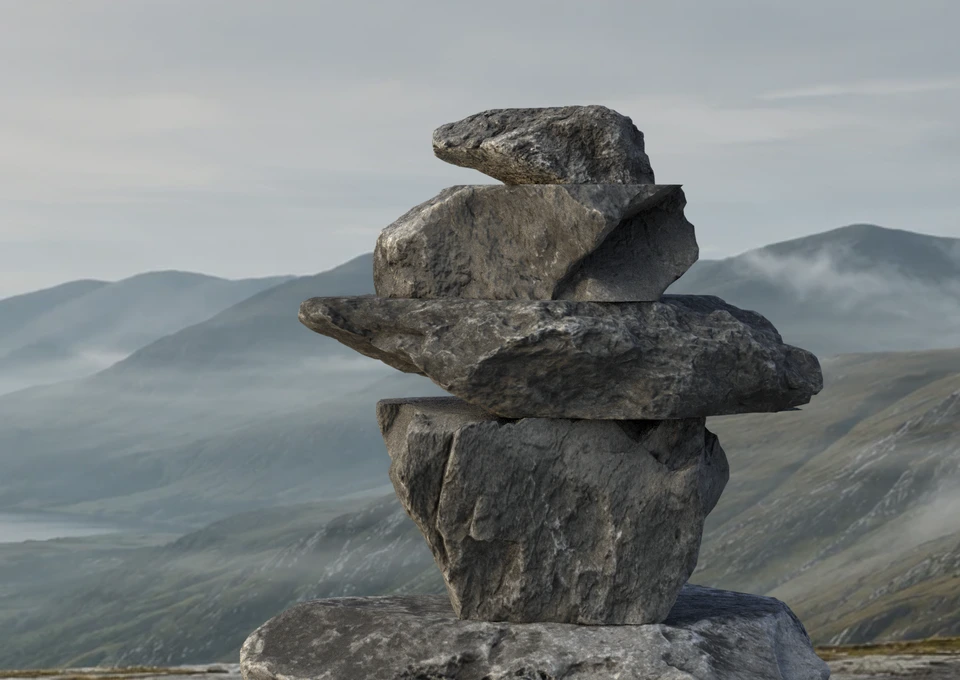
The stones move as you scroll on our homepage. This still shows the finished stack. The long stone sticks out on one side. Would it tip when we let go?
How does that help you?
For the stones, we checked what happened when we took a support away. For an online shop, we might ask what happens when it receives the same order twice. Does it take two items out of stock? We try the awkward case, show you the result and give you a way to check it yourself.
Follow the duplicated shop order · Try the diary and reminder example · See how Cairnscale can help
See how we tested the digital stones
Five contacts
At each joint we measured where the two surfaces meet. The margin is the shortest distance from the projected centre of mass of everything above the joint to the edge of its support polygon.
| Contact | Area cm² | Load kg | Margin mm |
|---|---|---|---|
| Ledge and base | 271.6 | 40.77 | 27.2 |
| Base and upright | 178.3 | 25.53 | 58.8 |
| Upright and crossing slab | 45.3 | 13.95 | 15.5 |
| Crossing slab and wedge | 114.7 | 5.69 | 33.9 |
| Wedge and cap | 60.2 | 1.28 | 13.5 |
Letting go
We released the loose stones and every stage of the stack under gravity. Each release ran for ten seconds at two friction coefficients, 0.45 and 0.65, and two solver rates, 240 and 480 steps per second. Across all 24 runs the largest movement was 0.54 mm and the largest turn was 0.13°.
As a control, we removed the second stone. The cap dropped 109 mm in a quarter of a second.
The lift is choreographed. We checked all 301 poses for intersections, including the ground and each landing, with a 0.05 mm tolerance at the ledge and the seated joints. The separate gravity test uses a level ledge, the visible bearing faces, uniformly dense rock at 2,600 kg/m³ and convex collision shapes. These measurements describe the digital model.
The stone
The grey and muted green palette takes its cue from the slate of the English Lake District. The five stones use adapted photogrammetry. The fell, light and moving cloud are digitally composed.
Lake District National Park · Building traditions British Geological Survey · Keswick district Mick Garratt · Slate at Dubs Quarry

Scan, ground detail and lighting courtesy of Poly Haven. Rock Moss Set 02 Rocky Terrain 02 Rocky Ridge CC0 licence